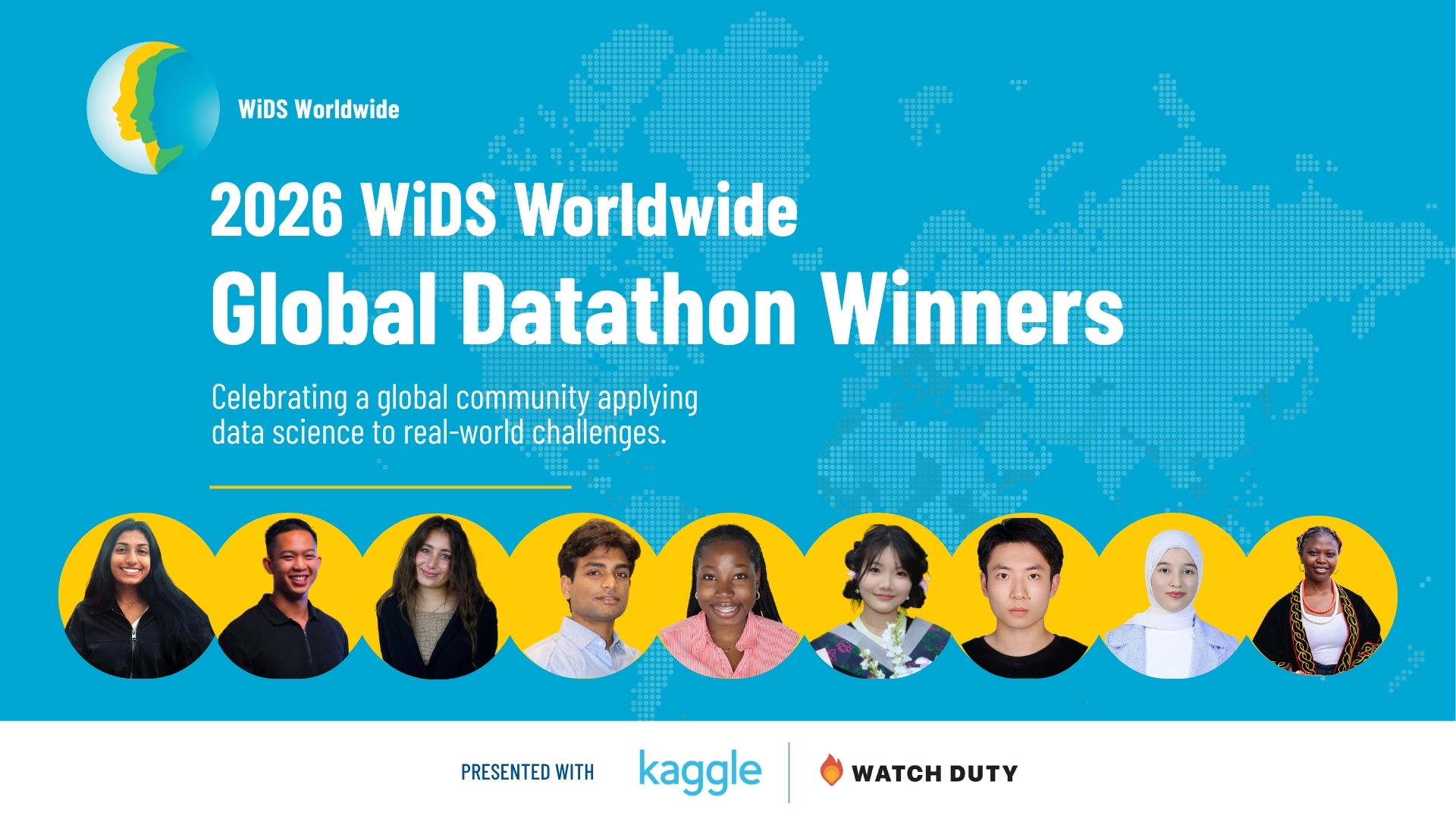
Each year, the WiDS Worldwide Global Datathon brings together a global community of data scientists, students, researchers, and professionals to tackle real-world, consequential problems through data. Since launching in 2018, the Datathon has challenged participants to apply data science to issues ranging from financial inclusion and healthcare equity to climate resilience, brain health, and public safety.
This year’s challenge, developed with Watch Duty, focused on wildfire impact and equity. Participants used survival analysis to predict wildfire spread and estimated arrival times, exploring how data-driven models could support earlier evacuation planning and emergency response.
The challenge attracted participants from around the world, generating more than 21,000 submissions over five months (a 33% increase from the previous year). What the leaderboard numbers alone can’t capture is the sheer human breadth of this year’s Datathon. Teams were forming across time zones, mentors were guiding first-time competitors, and universities were rallying students around a problem that felt genuinely urgent. Solo participants were building skills in Cotonou while student teams were representing their universities in Guayaquil. The competition became a common language spoken across wildly different contexts.
Reflecting on the impact of this year’s challenge, Valentina Torres da Silva, an M.S. Data Science student at Columbia University who collaborated with the WiDS team to develop this year’s wildfire challenge, shared:
“Helping shape a challenge that is applicable and impacts people is an honor. Thousands of people chose to spend their time on a problem where the predictions were tied to evacuation and response times. That’s the version of data science worth building towards.”
With only a few hundred training samples, the modeling that emerged reflected a shared understanding of the challenge. The strongest solutions treated overfitting as the central adversary and leaned on careful, physics-grounded feature engineering that captured distance to evacuation zones, rate of spread, and estimated time of arrival.
Where teams diverged was in their approach to survival classification. Some placed their trust in classical gradient boosting survival models for their stability on small datasets while others reached for neural architectures capable of smooth multi horizon regression. The most resilient solutions blended the two while enforcing the monotonicity the operational framing demanded. The team behind Trick is All You Need captured the lesson when they described learning “how to effectively ensemble different architecture models to improve prediction performance,” and HippoStatistics noted that this was “the first time we had to model survival analysis” at all.
It is our privilege to congratulate the teams who rose to the top of that field. Leading the global leaderboard, BTT_Mapping united Anjali Dev, Marcello Borromeo, and Swetha Upadrasta, three students who first met through Break Through Tech AI program and entered the datathon as part of a cohort of more than two hundred student teams. Reflecting on the climb, they told us, “As a student team, we never expected to win a worldwide competition, and that turned out to be our advantage. We stopped measuring ourselves against the field and set our minds on the work in front of us, leaning on one another and finding small ways to be better than the submission before, keeping at the grindstone with no guarantees that any of it would pay off. What carried us was aspiration without expectation and the understanding that there is no shortcut for the patient and sometimes agonizing work that real progress demands. Seeing that effort recognized on a global stage gave us a real blast of confidence and deepened our commitment to careers in data science and data engineering.”
They were joined at the top of the leaderboard by four teams whose work was separated by only thousandths of a point. BTT_Heatwave finished second from Ayooluwa Wojuade and Rishik Yesgari, who were struck, in their words, by “how much feature engineering, ensemble learning, and carefully tracking the right evaluation metric can improve a model.” Trick is All You Need took third through Haoyang Jiang and Jiayi Ding of South China Agricultural University, HippoStatistics earned fourth from a deliberate cross university collaboration in Bucharest, and Bob the Builder(s), the work of Mumtahina Ambrin in Dhaka, rounded out the top five in what she described as her first ever competition, entered, in her words, “to learn through real world experience.”
Across the other tracks the same spirit held. Kagglettes claimed first place among students through Ilona Le Drogoff and Mellissa Hafis of Paris Dauphine University, who came to understand that “a model’s accuracy is only as valuable as the trust they can place in its probability estimates.” BTT_Blackline took second with Charlotte Huang and Krrish Kohli, who learned through the Break Through Tech AI Program how small adjustments to a model, its data engineering, and its hyperparameters “can significantly increase or decrease its predictability.” Rola Islait won the top high school honor competing alone from Jerash, Jordan, and offered the truth that “even as a solo high school student, you can tackle real world problems that matter,” adding that persistence and curiosity carry as much weight as technical skill. Lucia Yen earned the top first timer award from Kigali, Rwanda, in her first competition beyond the classroom, delivering a solution careful enough to carry its own built-in check that confirmed the winning file. To every one of these teams, and to all who competed, we offer our sincere admiration.
Looking ahead, the WiDS Global Datathon 2027 will turn from fire to water, taking up the urgent and worldwide question of water scarcity and availability, and we hope this year’s participants will carry their momentum into a challenge that touches the lives of billions. None of this would be possible without our partners. We thank Kaggle for hosting the competition and generously supporting the prize pool, and WatchDuty, whose hyperlocal emergency intelligence and wildfire data gave the challenge its grounding in lives actually protected.