
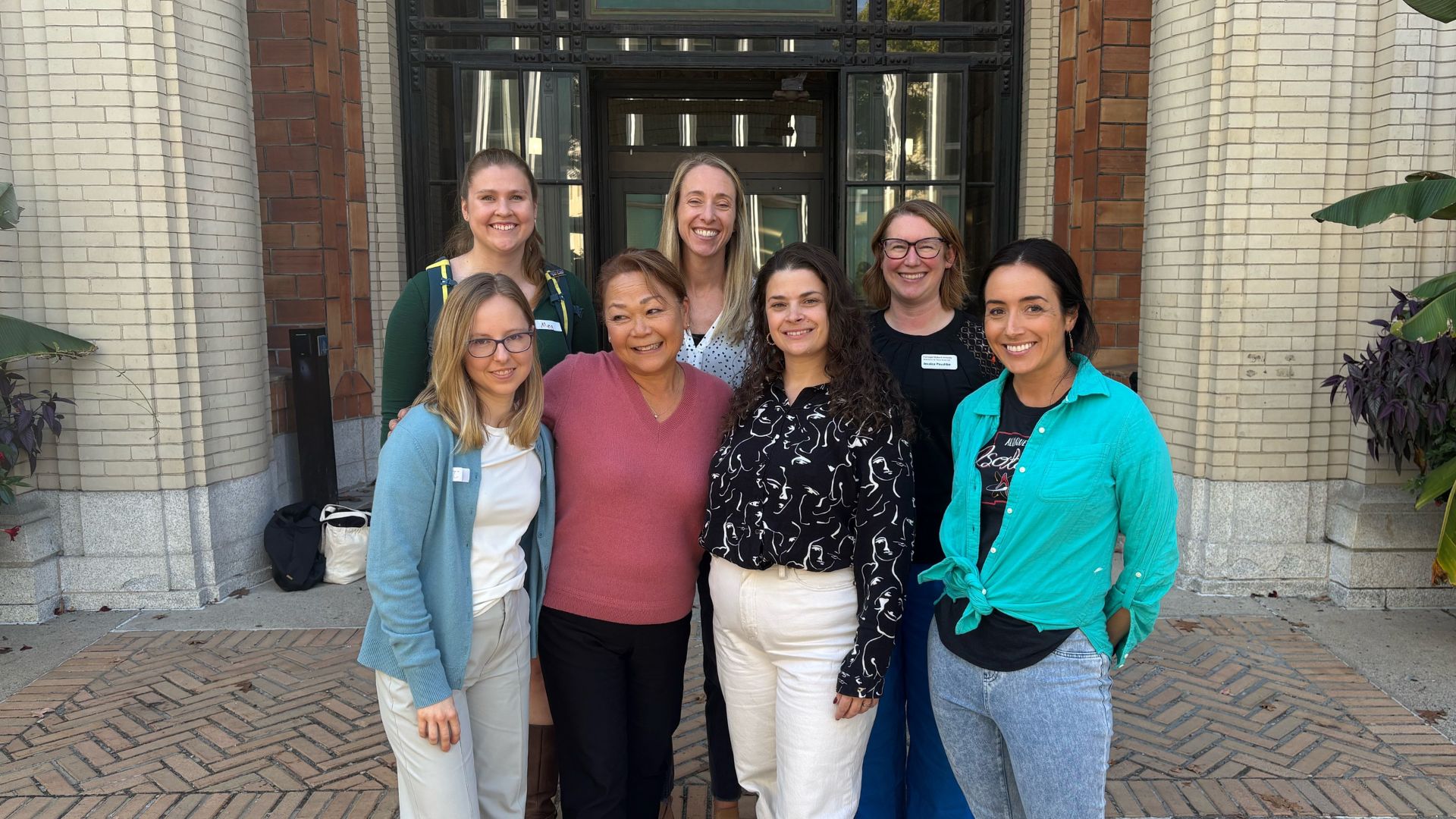
Inside CMU’s Inspire Workshop — Featuring Selina Carter, Meg Ellingwood, Julia Walchessen, and the CMU WiDS Ambassadors
When the Carnegie Mellon University (CMU) team piloted their Inspire Workshop earlier this year, the results were clear: when high-school students are invited to question, experiment, and build, their confidence in data science doesn’t just grow — it accelerates.
This impact story, shared by lead instructor Selina Carter, a PhD candidate in Statistics & Machine Learning at CMU, embodies the spirit behind the new WiDS Inspire Curriculum. The workshop blended curiosity, real-world applications, and accessible coding exercises, helping students see themselves not just as users of AI tools, but as emerging creators.
The workshop was supported by WiDS CMU Ambassadors Rebecca Nugent and Jessie Albright, whose leadership continues to expand opportunities for students across the region.
A Global Journey That Led to the Classroom
Selina’s path into data science is anything but conventional.
Raised in rural Maine and fluent in Spanish, Portuguese, and Turkish, her early career took her across the world: Peace Corps Ecuador, Fulbright Portugal, microfinance leadership in Turkey, and field research coordination in Mozambique.
Through these experiences — from leading vaccination survey teams to analyzing micro-loan impacts — Selina discovered that meaningful progress requires not just data, but the ability to interpret and question it.
“Understanding community problems requires mathematical tools that illuminate data.”
— Selina Carter
Today, as a doctoral researcher, she brings that same applied perspective into the classroom.
Why the Inspire Model Works: Students Who Question Everything
For Selina, the most exciting part of teaching the Inspire Workshop was listening to the students’ reactions.
“They care about social issues. They get mad. They have ideas. They question everything — especially a chat bot.”
One of the workshop’s most memorable moments came when students compared outputs from a language model using the exact same prompt. The differences surprised them — sparking a discussion on deterministic vs. probabilistic modeling.
By pairing conversation with hands-on creation, the workshop shifted their mindset. Students didn’t just observe AI; they built with it.
During an introductory R lesson, they created the same types of plots they had asked the chatbot to generate. That moment of direct control was transformative.
“They realized they could not only use a tool… they could build one.”
Addressing Misconceptions Through Experiential Learning
Students often assume AI systems behave the same way every time. By encouraging them to test, compare, and critique outputs, Selina created a space where misconceptions dissolved naturally.
Her guiding principle for the workshop was simple:
“I want them to walk away knowing they have the power to question and challenge these tools.”
This aligns with the core goal of the Inspire Curriculum: to cultivate thoughtful, confident, and critically engaged learners.
Looking Ahead — and Continuing Momentum at CMU
Selina plans to complete her PhD and continue working on meaningful problems — whether in academia or industry. She is committed to guiding future students as they navigate data science, ask thoughtful questions, and contribute their perspectives to the field. Her commitment reflects the broader culture of the CMU WiDS community, with ambassadors Rebecca Nugent and Jessie Albright helping guide and shape its growth.
Together, their efforts demonstrate how Inspire Workshops can thrive when supported by engaged instructors and strong institutional partners.
For Future Inspire Workshop Instructors
Selina’s experience offers several takeaways for anyone preparing to lead a workshop:
1. Let students compare results and debate openly.
Variation in AI output is a powerful teaching moment.
2. Pair conceptual lessons with small, confidence-building coding exercises.
Even simple plots can shift students from passive users to active creators.
3. Encourage conversation, critique, and curiosity.
Students bring strong opinions and questions — the workshop is their space to explore them.
4. Share your own path into data science.
Real stories help students understand how many routes lead into the field.
The Impact: Students Leave Feeling Capable and Curious
By the end of the workshop, students felt more confident not just in using AI, but in understanding and shaping it. That shift — from consuming technology to questioning and creating it — is exactly what Inspire aims to cultivate.
As we launch the WiDS Inspire Curriculum, we’re excited to highlight educators like Selina Carter and the CMU Ambassadors who are helping build the next generation of engaged, thoughtful data science learners. We extend a special thank you to the PPG Foundation, whose generous grant helped make this workshop possible. To explore the Inspire Curriculum and learn how you can bring a workshop to your community, visit our WiDS NextGen page.
Written by Emily Lee, Marketing Manager, WiDS Worldwide